cDNA preparation for qPCR, with premixed primers and a separate genomic DNA-removal component.
From £51.76 ex VAT · 2 pack sizes
Loading purchase options…
Product information
Overview
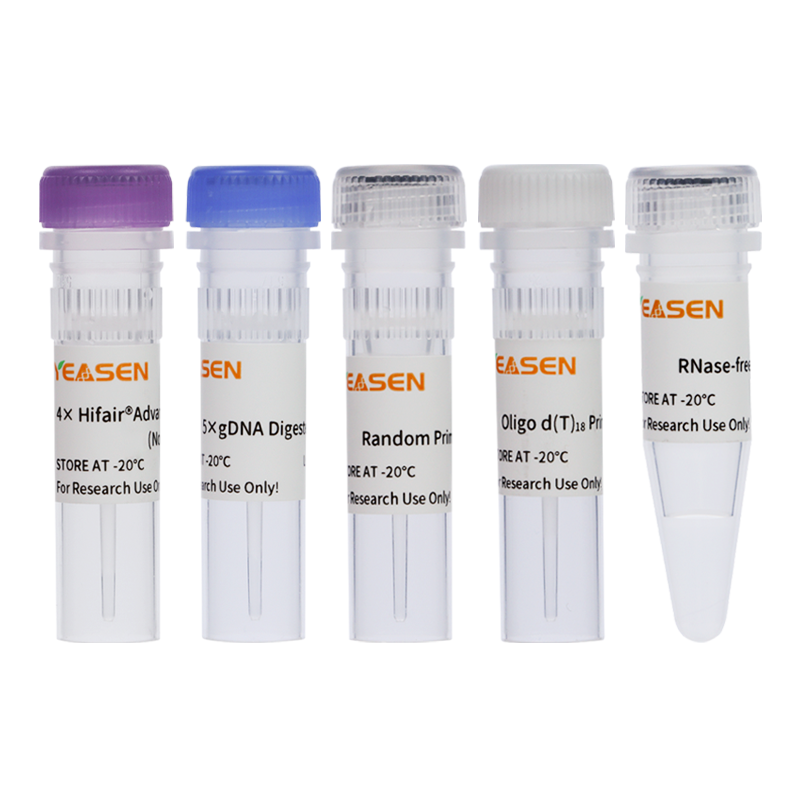
Hifair AdvanceFast 11155 is a reverse transcription kit with gDNA removal for preparing cDNA before qPCR. It includes premixed primers and a separate gDNA Digester Mix-V2. The cDNA is suitable for dye- or probe-based gene-expression analysis.
Primer format
Random and oligo(dT) primers premixed
DNA removal
gDNA Digester Mix-V2 included
Stated incubation
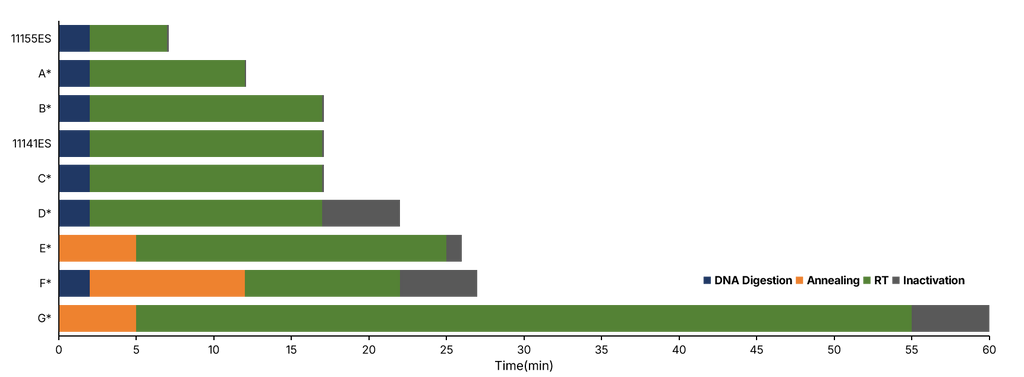
5-minute RT; 7 min 5 sec including DNA digestion and inactivation, excluding setup and ramping
Downstream use
qPCR; not recommended for long-fragment amplification
Features and manufacturer data
Hifair AdvanceFast 11155 is a premixed reverse-transcription kit for cDNA preparation before dye- or probe-based qPCR. It includes random and oligo(dT) primers in the SuperMix and a separate gDNA Digester Mix-V2. YEASEN's programme combines two minutes of DNA digestion, five minutes of reverse transcription and five seconds of inactivation: 7 minutes 5 seconds of stated incubation, excluding setup and instrument ramping. It is not recommended for long-fragment gene-cloning applications.
Prices are in GBP. VAT-inclusive amounts use 20% VAT. Delivery is calculated at checkout. Select a pack size to check availability or request a quotation.
Specifications
Downstream use
Dye- or probe-based qPCR
Primer format
Premixed random and oligo(dT) primers
DNA-removal component
gDNA Digester Mix-V2
Manufacturer reaction basis
20 µL RT reaction; 10 T or 100 T packs
Routine total-RNA input
10 pg–2 µg; up to 5 µg for low-expression targets under the manual's qualification
Components
Component code
Name
11155ES10
11155ES60
11155-A
Hifair ™ AdvanceFast SuperMix
60 μL
600 μL
11155-B
gDNA Digester Mix -V2
20 μL
200 μL
11155-C
RNase Free H 2 O
200 μL
2×1 mL
Application data and case studies
Application figures supplied by YEASEN. Open the linked source for the application data.
Figures
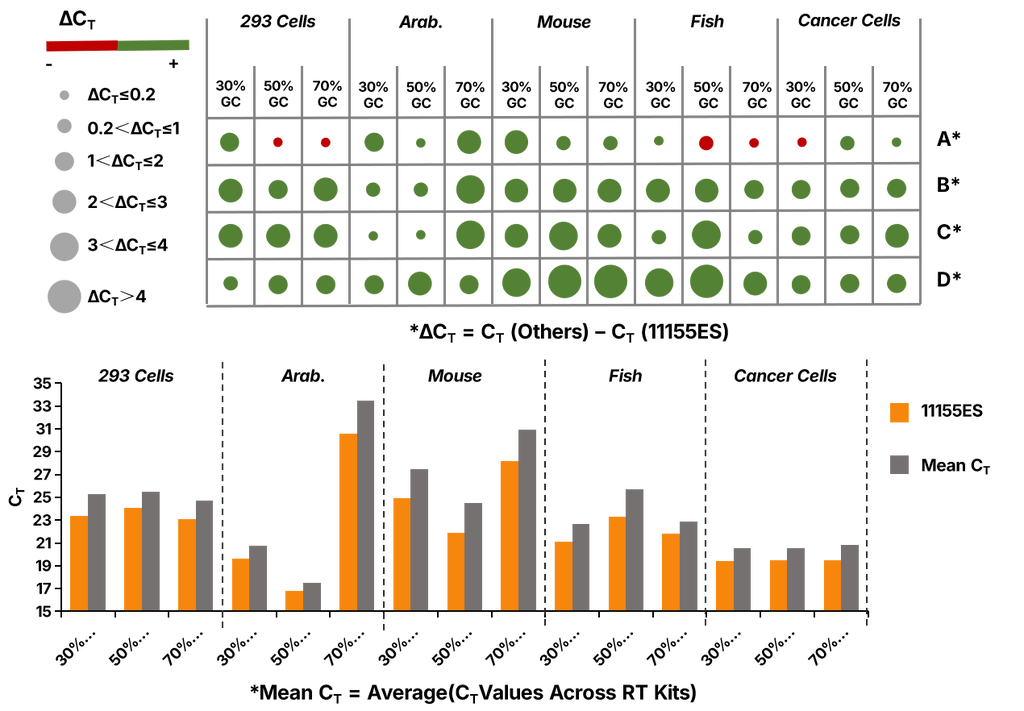
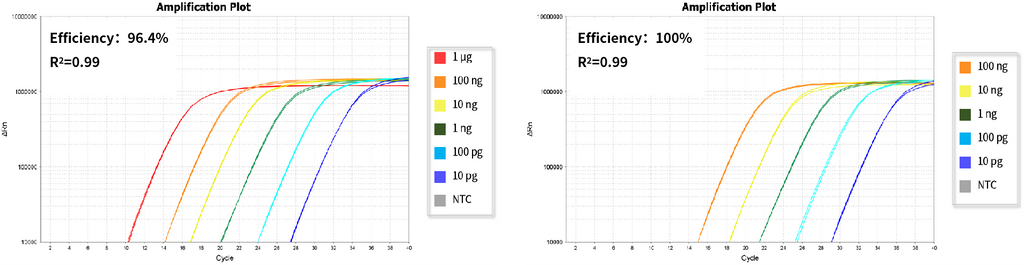
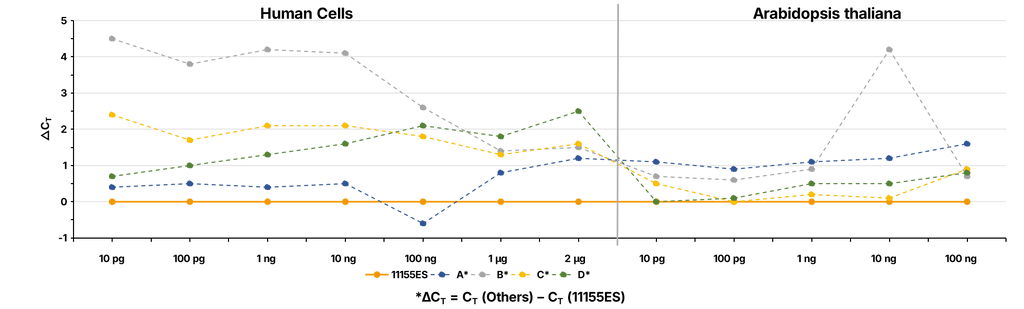
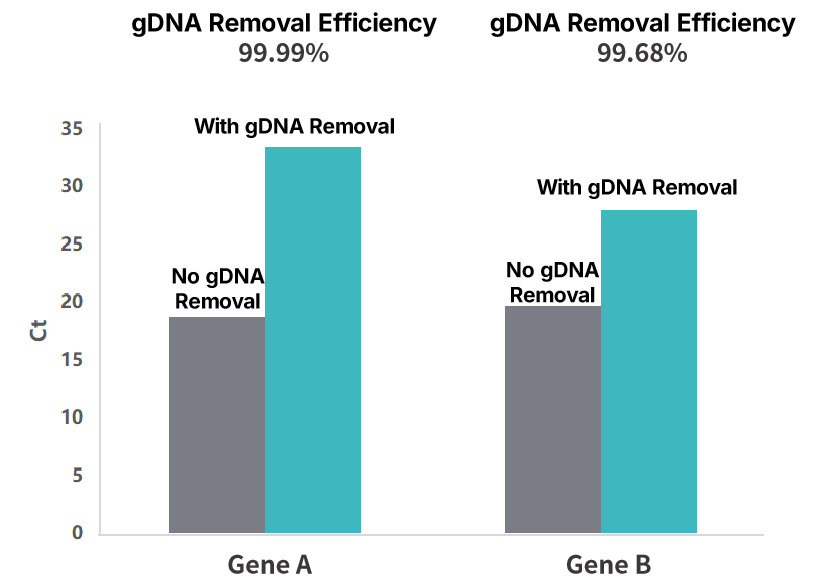
YEASEN supplies qPCR comparisons with human 293T and Arabidopsis RNA, a 1,000 ng genomic-DNA digestion example, and stability experiments. The figures report results under their stated conditions, not universal superiority or freedom from inhibitors.
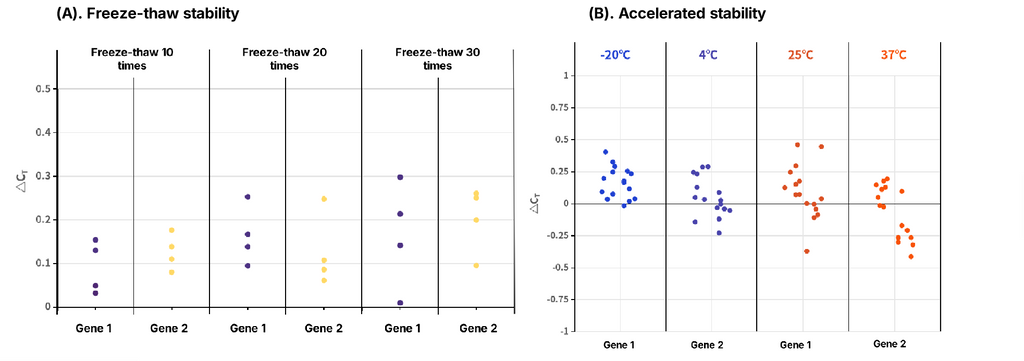
The stability data distinguish reagent testing after up to 30 freeze–thaw cycles from a separate seven-day cDNA-storage experiment. Reported Ct differences were no more than 0.5 in those experiments; these are not recommendations to repeatedly thaw reagents or change their storage conditions.
Manufacturer workflow comparison for 11155ES. The specified incubations total 7 minutes 5 seconds, excluding preparation and instrument ramping.Figure 2. Reverse Transcription Efficiency ComparisonFigure 3. Reverse Transcription Sensitivity ComparisonFigure 3, companion panel. Manufacturer ΔCt comparison across human-cell and Arabidopsis RNA inputs; ΔCt = Ct(other reagent) − Ct(11155ES).Figure 4. gDNA Digestion/Removal Capability ComparisonFigure 5. Manufacturer stability experiments: reagent testing after 10, 20 and 30 freeze–thaw cycles, and cDNA storage at −20°C, 4°C, 25°C and 37°C versus −80°C. These experiments do not replace reagent-storage instructions.
With DNA removal: combine 2 µL gDNA Digester Mix-V2, RNA and RNase-free water to 14 µL. Incubate at 37°C for 2 minutes, then add 6 µL AdvanceFast SuperMix.
Without DNA removal: combine 6 µL SuperMix, RNA and RNase-free water to 20 µL. Primers are already included.
For either route, incubate at 50°C for 5 minutes, then 85°C for 5 seconds. Assemble on ice, mix gently and briefly centrifuge.
Routine total-RNA input: 10 pg–2 µg; the manual permits up to 5 µg for low-expression targets. mRNA input: 10 pg–500 ng. Follow the linked manual for the complete procedure.
Frequently asked questions
Do I add separate reverse-transcription primers?
The SuperMix contains random N6 and oligo(dT) primers for the stated qPCR workflow. If you require control over the priming approach, compare the separate-primer 11150 kit.
Does 10 T mean ten qPCR plates?
No. It means ten reverse-transcription reactions at the manufacturer's 20 µL basis. The number of downstream qPCR wells depends on template use, dilution, targets, controls and replicates.
Can I use this for long cDNA amplification?
The 11155 manual does not recommend it for long-fragment amplification such as gene cloning and points to 11150 for that purpose.
Should I extend the 11155 reverse-transcription incubation?
YEASEN advises keeping this kit's specified programme; extending the RT incubation can delay Ct values.
How should completed reactions be held in the thermocycler?
Add a 4°C hold after inactivation if the tubes will remain in the instrument.
Why can more RNA produce a later Ct?
More RNA may also add inhibitors. Assess RNA input and cDNA dilution rather than assuming a larger input improves the assay.
Can absorbance measure cDNA concentration in the mixed RT product?
Residual RNA, protein, salts and dNTPs affect absorbance. Control RNA input before RT instead of interpreting the mixed product's absorbance as cDNA concentration.
Does YEASEN mention short-term storage at 4°C?
Its product-page FAQ permits up to two weeks after opening when contamination is avoided. Long-term storage remains −25°C to −15°C for one year; follow the supplied batch information.
Notes
1. This product is for research use only.
2. Please operate with lab coats and disposable gloves,for your safety.
3. Perform all pipetting and mixing steps on ice to maintain sample integrity.
4. Gently invert and centrifuge each component at low speed before use to ensure proper mixing.
Citations and references
[1] Yuan B, Peng Q, Cheng J, et al. Structure of the Ebola virus polymerase complex. Nature. 2022;610(7931):394-401. doi:10.1038/s41586-022-05271-2 (IF:69.504)
[2] Bi Q, Wang C, Cheng G, et al. Microglia-derived PDGFB promotes neuronal potassium currents to suppress basal sympathetic tonicity and limit hypertension. Immunity. 2022;55(8):1466-1482.e9. doi:10.1016/j.immuni.2022.06.018 (IF:43.474)
[3] You XJ, Zhang S, Chen JJ, et al. Formation and removal of 1,N6-dimethyladenosine in mammalian transfer RNA. Nucleic Acids Res. 2022;50(17):9858-9872. doi:10.1093/nar/gkac770 (IF:19.160)
[4] Ni X, Wu W, Sun X, et al. Interrogating glioma-M2 macrophage interactions identifies Gal-9/Tim-3 as a viable target against PTEN-null glioblastoma. Sci Adv. 2022;8(27):eabl5165. doi:10.1126/sciadv.abl5165 (IF:14.957)
[5] Chen Y, Shen J, Zhang L, et al. Nuclear translocation of OsMFT1 that is impeded by OsFTIP1 promotes drought tolerance in rice. Mol Plant. 2021;14(8):1297-1311. doi:10.1016/j.molp.2021.05.001 (IF:13.164)
[6] Yang L, Chen Y, Xu L, et al. The OsFTIP6-OsHB22-OsMYBR57 module regulates drought response in rice. Mol Plant. 2022;15(7):1227-1242. doi:10.1016/j.molp.2022.06.003 (IF:13.164)
[7] Song JM, Xie WZ, Wang S, et al. Two gap-free reference genomes and a global view of the centromere architecture in rice. Mol Plant. 2021;14(10):1757-1767. doi:10.1016/j.molp.2021.06.018 (IF:13.164)
[8] Lin QY, Zhang YL, Bai J, Liu JQ, Li HH. VEGF-C/VEGFR-3 axis protects against pressure-overload induced cardiac dysfunction through regulation of lymphangiogenesis. Clin Transl Med. 2021;11(3):e374. doi:10.1002/ctm2.374 (IF:11.492)
[9] Zhang L, Zhang F, Zhou X, et al. The tetratricopeptide repeat protein OsTPR075 promotes heading by regulating florigen transport in rice [published online ahead of print, 2022 Jun 28]. Plant Cell. 2022;koac190. doi:10.1093/plcell/koac190 (IF:11.277)
[10] Mao Z, Xiao H, Shen P, et al. KRAS(G12D) can be targeted by potent inhibitors via formation of salt bridge. Cell Discov. 2022;8(1):5. Published 2022 Jan 25. doi:10.1038/s41421-021-00368-w (IF:10.849)
[11] Li M, Chen J, Liu Y, et al. Rational design of AAVrh10-vectored ACE2 functional domain to broadly block the cell entry of SARS-CoV-2 variants. Antiviral Res. 2022;205:105383. doi:10.1016/j.antiviral.2022.105383 (IF:10.103)
[12] Luo F, Yang W, Yin M, et al. A chromosome-level genome of the human blood fluke Schistosoma japonicum identifies the genomic basis of host-switching. Cell Rep. 2022;39(1):110638. doi:10.1016/j.celrep.2022.110638 (IF:9.423)
[13] Wang X, Lin C, Wu S, et al. Cannabidivarin alleviates neuroinflammation by targeting TLR4 co-receptor MD2 and improves morphine-mediated analgesia. Front Immunol. 2022;13:929222. Published 2022 Aug 10. doi:10.3389/fimmu.2022.929222 (IF:8.786)
[14] Jiang R, Su G, Chen X, et al. Esculetin inhibits endometrial cancer proliferation and promotes apoptosis via hnRNPA1 to downregulate BCLXL and XIAP [published online ahead of print, 2021 Sep 1]. Cancer Lett. 2021;521:308-321. doi:10.1016/j.canlet.2021.08.039 (IF:8.679)
[15] Wu ZG, Zou XH, Chen C, et al. Engineered CAR-monocytes coordinate fibrosis clearance and cardiac regeneration following myocardial infarction. Cell Stem Cell. 2026;33(6):1-17. doi:10.1016/j.stem.2026.04.003 (IF:20.4)