
Product selection guide
Two-step RT-qPCR: a reagent checklist from RNA to instrument
For two-step RT-qPCR, choose a reverse-transcription kit to make cDNA and a separate qPCR mix for amplification and detection. Match the cDNA kit format, assay chemistry and instrument reference-dye requirements, then check the controls and consumables needed to complete the workflow.
Based on manufacturer specifications. Product documents and sources.
What is the difference between an RT kit and a qPCR master mix?
Two-step RT-qPCR uses a reverse-transcription kit to prepare cDNA, followed by a separate qPCR master mix for amplification and detection.
The Yeasen products below are separate RT and qPCR products. Purchasing them together does not turn them into a one-step RT-qPCR formulation. Check the instructions and template requirements for each stage.
Sources: Yeasen 11150 specifications; Yeasen 11155 specifications; Yeasen 11184 specifications
Should you choose separate primers or a premixed cDNA SuperMix?
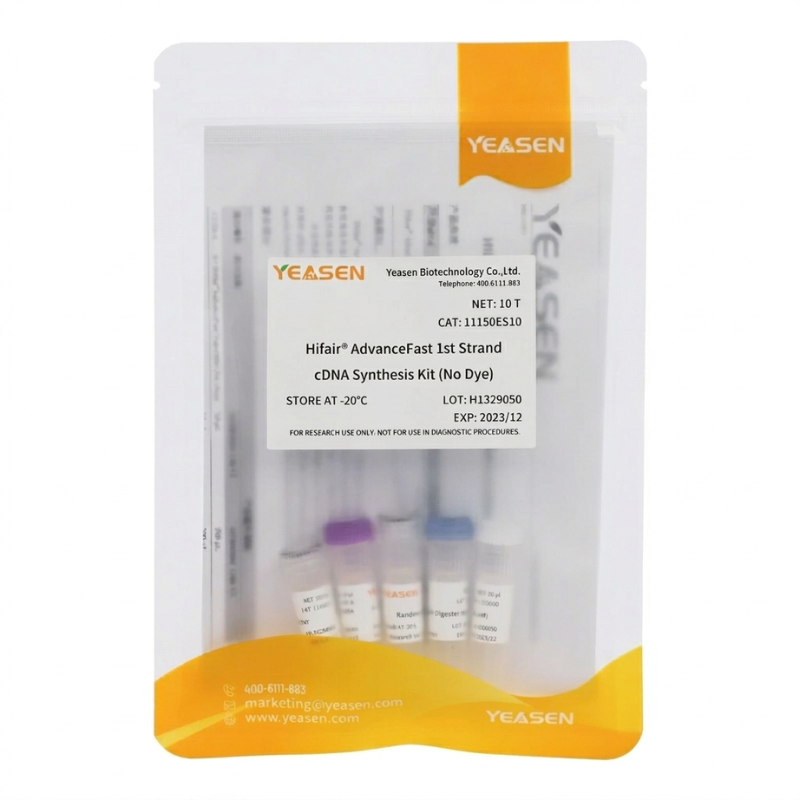
Yeasen 11150 supplies random and oligo-dT primers separately. Yeasen 11155 incorporates primers into a SuperMix intended for downstream qPCR. Choose according to the primer presentation and downstream use your laboratory requires.
Yeasen does not recommend 11155 for long-fragment cloning applications and points users to its 11150 kit for that purpose. Do not treat all cDNA synthesis products as having the same application scope.
Sources: Yeasen 11150 specifications; Yeasen 11155 specifications
Does a genomic DNA-removal component replace the control plan?
Both 11150 and 11155 include genomic DNA-removal components. That feature does not by itself prove that residual DNA cannot affect a particular assay.
A no-RT control helps assess amplification attributable to DNA rather than reverse-transcribed RNA. A no-template control checks for amplification in the absence of added sample template. They answer different questions. The cited control definitions come from general manufacturer guidance; they do not imply that the Yeasen kits include a dedicated no-RT control formulation.
Sources: Yeasen 11150 specifications; Yeasen 11155 specifications; Thermo Fisher: no-RT and no-template control concepts (page 8)
Is a SYBR qPCR mix suitable for every detection chemistry?
Yeasen 11184 is a SYBR dye-based qPCR master mix. Match it to an appropriate dye-based assay and suitable DNA or cDNA template. Do not infer probe-assay suitability from the fact that both formats are described as qPCR.
If your assay requires probe detection, select a formulation explicitly intended for that chemistry. The upstream cDNA step and the downstream detection chemistry are separate purchasing decisions.
Sources: Yeasen 11184 specifications
What do the fast RT and qPCR timings actually describe?
11155 provides a five-minute reverse-transcription incubation. Including DNA digestion and inactivation gives 7 minutes 5 seconds of specified incubation, excluding preparation and instrument ramping. It is not the time to a completed qPCR result.
11184's current manual specifies 20-second annealing/extension in the fast programme and 30 seconds in the standard programme. Check the manufacturer’s guidance for your instrument and programme.
Sources: YEASEN 11155 manual — EN20260202; YEASEN 11184 manual — body revision EN20260609; Yeasen 11155 specifications
What is the difference between blue tracking dye and ROX?
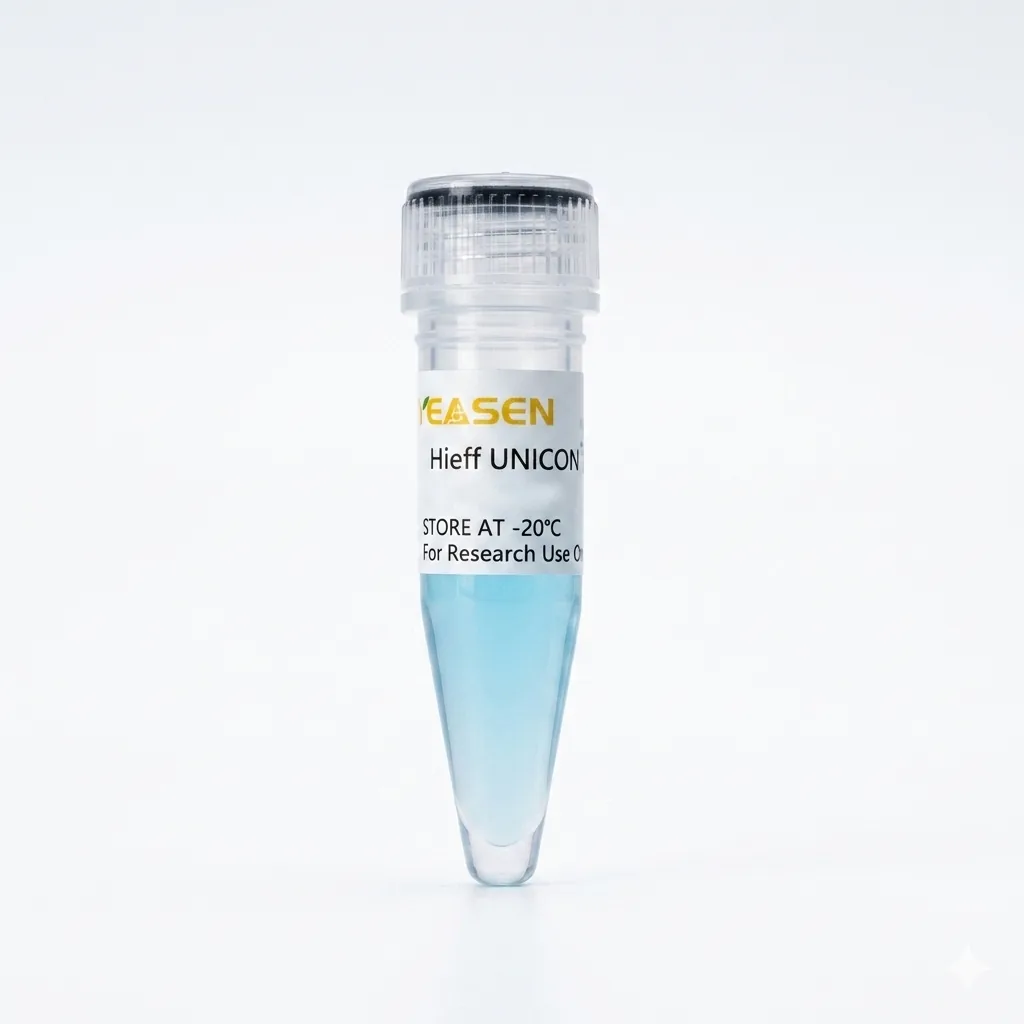
In Yeasen 11184, the blue colour is a visual tracking aid; ROX is the passive reference dye. These serve different roles. The visible blue colour does not set the instrument's reference-dye configuration or guarantee that a reaction has been prepared correctly.
Yeasen describes the formulation as suitable for most qPCR instruments. Check your exact model, detection channel and passive-reference settings against the current product and instrument documentation. The word ‘Universal’ does not establish compatibility with every instrument.
Sources: Yeasen 11184 specifications
What should you check about melt curves when comparing SYBR qPCR mixes?
Include the melt-curve result in an evaluation, not just the Cq value. YEASEN's guidance describes several possible contributors to unusual peaks, including primer dimers, non-specific products, the instrument and reagent composition. The shape alone does not identify one cause.
The same target can show a different melting temperature in a different reagent environment. A changed peak position is therefore not, on its own, proof of a different product or of a better mix. Keep the relevant controls and instrument information with the comparison, and consult the product-specific guidance before drawing a conclusion.
Sources: YEASEN: interpreting unusual qPCR melt curves; Thermo Fisher: no-RT and no-template control concepts (page 8)
What belongs on a complete two-step RT-qPCR purchasing list?
Check the full workflow before ordering. Reaction counts on separate RT and qPCR packs describe their own use basis; adding them together does not give a combined assay capacity. Confirm the amount needed at each stage with your laboratory's method.
- RT kit with the required primer format and DNA-removal components.
- qPCR master mix matched to the assay chemistry and exact instrument model.
- Assay primers, and probes if required by the chosen detection format.
- Appropriate templates, control materials and instrument-compatible consumables.
- Exact catalogue numbers, pack descriptions and quantities for the quotation.
Sources: Yeasen 11150 specifications; Yeasen 11155 specifications; Yeasen 11184 specifications; Thermo Fisher: no-RT and no-template control concepts (page 8)
Products and pack sizes
Select a product to view pack sizes and availability. Prices exclude VAT; delivery is calculated at checkout.
Reverse Transcription
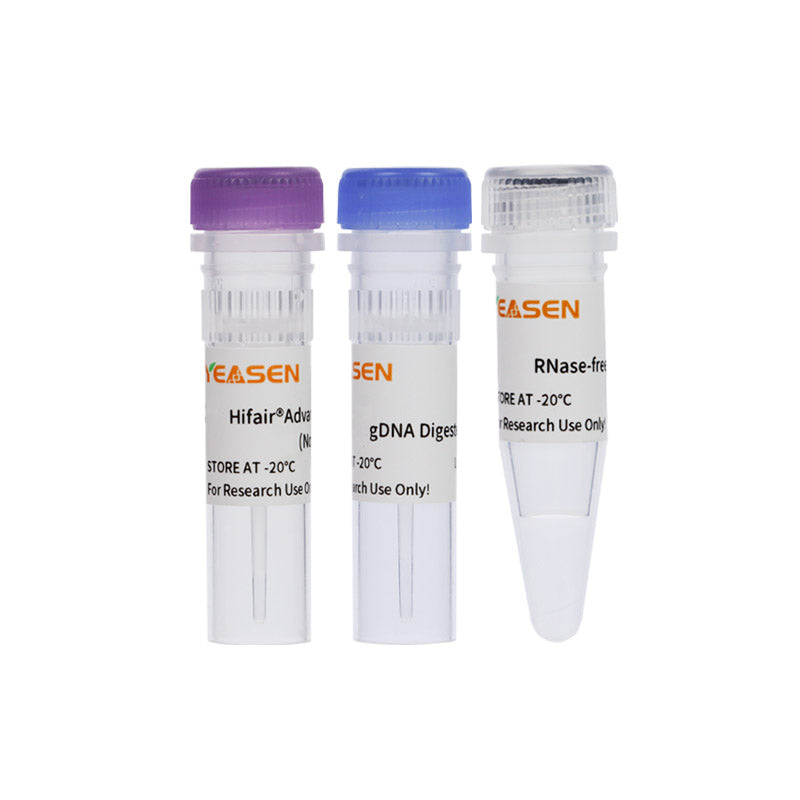
Hifair™ AdvanceFast 1st Strand cDNA Synthesis SuperMix for qPCR (gDNA digester plus)
11155 · 2 pack sizes
Need help choosing? Contact our team, request a quotation or request a free sample. Samples are subject to approval and availability.
Sources and further reading
- Yeasen 11150 specifications
- Yeasen 11155 specifications
- Yeasen 11184 specifications
- YEASEN 11150 manual — EN20240201
- YEASEN 11155 manual — EN20260202
- YEASEN 11184 manual — body revision EN20260609
- YEASEN: interpreting unusual qPCR melt curves
- Thermo Fisher: no-RT and no-template control concepts (page 8)
Follow the current instructions for the exact product and instrument you use. Products are for research use only.