
Product selection guide
How to choose a protein ladder for western blotting
Choose a prestained protein ladder that covers your expected target size. Check the band map and calibration for your gel and buffer system before interpreting the molecular weight.
Based on manufacturer specifications. Product documents and sources.
What does a prestained protein ladder tell you?
A prestained molecular-weight marker provides visible reference bands during SDS-PAGE and transfer. Its labelled masses support approximate sizing. If accurate molecular-weight estimation is central to the experiment, compare the manufacturer's advice on prestained and unstained standards before choosing.
Keep the ladder's role separate from identifying or quantifying your target protein. A band at an expected position is one piece of evidence, rather than confirmation of protein identity.
Sources: Thermo Fisher: protein standards selection; Yeasen 20352 manual, EN20250618
Which range brackets your target protein?
Compare the bands around your expected protein size, not only the range endpoints. The 300 kDa option extends the upper range but provides no reference bands below 25 kDa.
These prestained markers let you monitor protein separation and follow the marker bands during western transfer. A wider range does not necessarily give better resolution near your target. Check the gel system and transfer guidance as well.
| Product | Range and band count | Coloured reference bands |
|---|---|---|
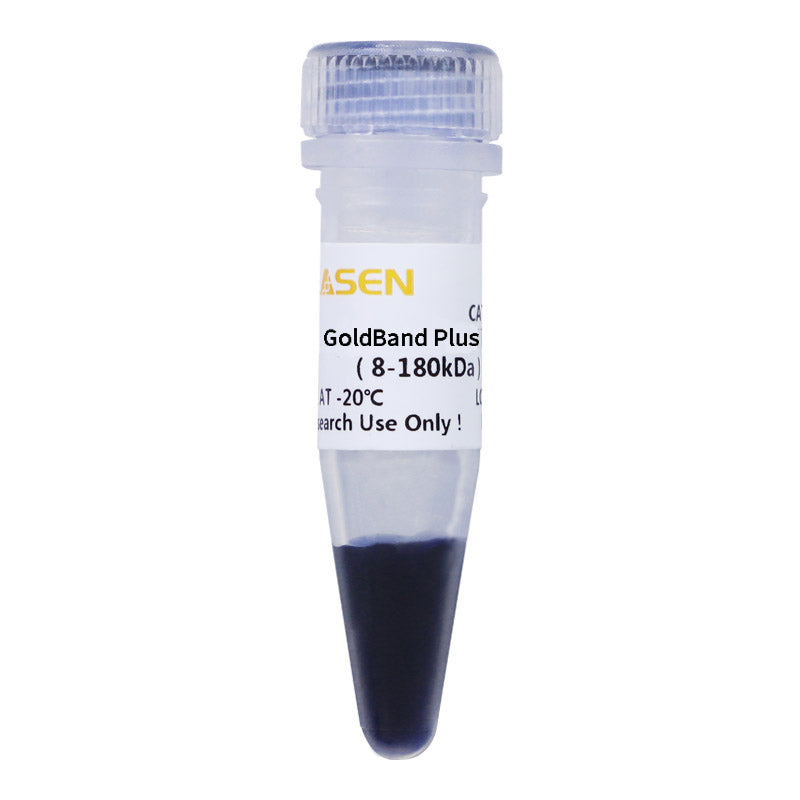
| 20350 · Regular Range | 8–180 kDa · 10 bands | 8 kDa green; 72 kDa orange |
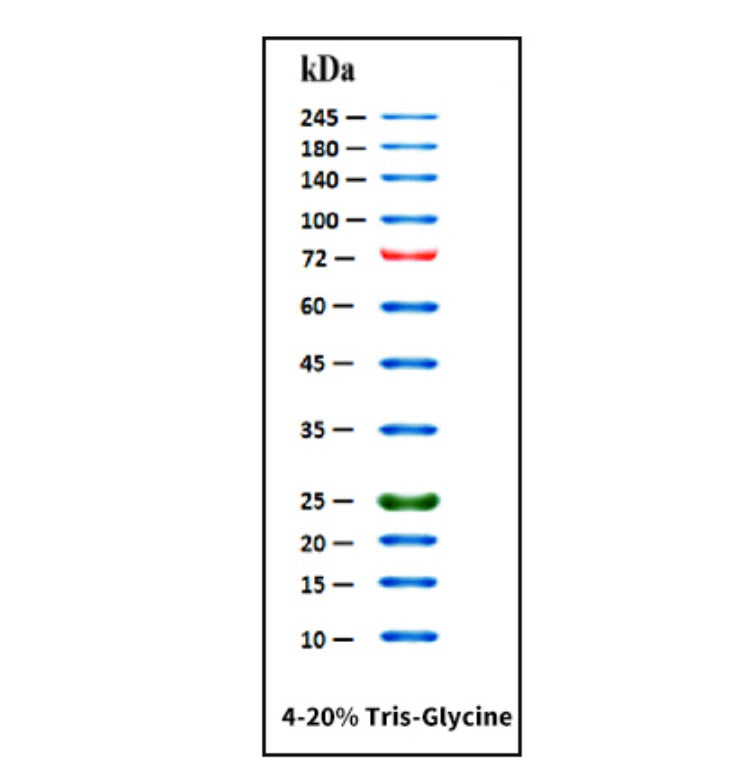
| 20352 · High Range | 10–245 kDa · 12 bands | 25 kDa green; 72 kDa orange |
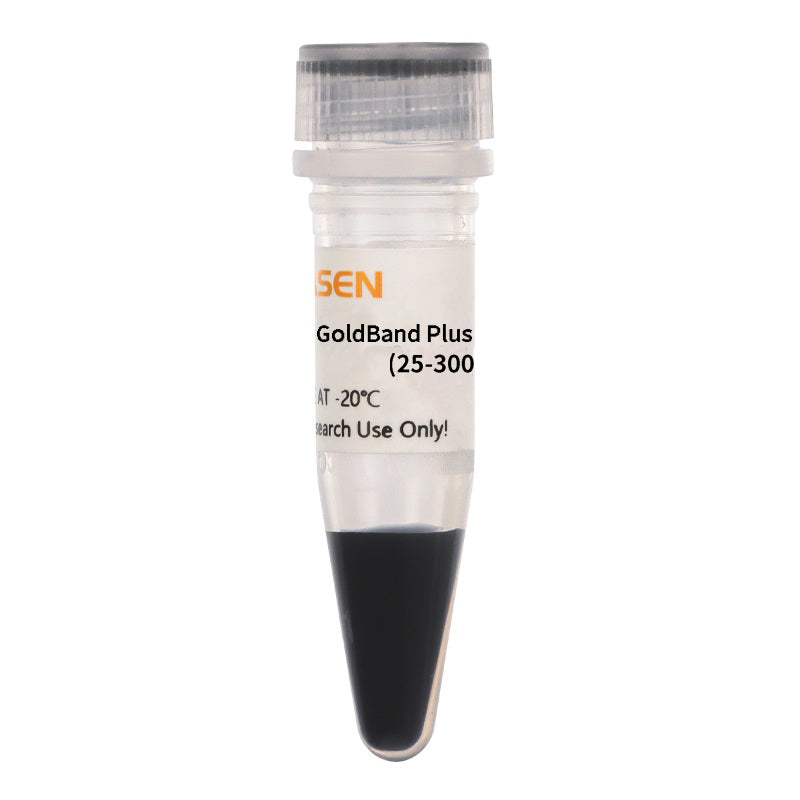
| 20347 · High MW | 25–300 kDa · 9 bands | 25 kDa green; 72 kDa orange |
Sources: Yeasen 20350 specifications; Yeasen 20352 specifications; Yeasen 20347 specifications
Why can protein ladder sizes change with the gel system?
Prestained proteins can migrate differently in different electrophoresis systems. Read the calibration that matches your gel and buffer, such as Tris-glycine or Bis-Tris, rather than transferring one system's labels automatically to another.
Yeasen 20352 provides system-specific apparent molecular-weight information. Keep the relevant manufacturer table with your image record. This is preferable to estimating a universal conversion between gel systems.
Sources: Thermo Fisher: protein standards selection; Yeasen 20352 specifications; Yeasen 20352 manual, EN20250618
Does a green reference band always mean the same size?
No. Reference colours identify bands within a particular ladder. The green band in Yeasen 20350 is 8 kDa; in 20352 and 20347 it is 25 kDa. All three have a nominal 72 kDa reference band, but their complete patterns differ.
For 20352, the nominal 72 kDa reference is labelled 65 kDa in Bis-Tris and 66 kDa in HEPES-Tris. Its manual description calls the band orange, while the calibration table calls it red. Use band position and the correct calibration rather than colour wording alone.
Sources: YEASEN 20350 manual, HB230116; Yeasen 20352 manual, EN20250618; YEASEN 20347 manual, HB221103
Should you heat or dilute these protein ladders?
The manuals for all three ladders say they are ready to load and should not be heated, diluted or supplemented with reducing agents. They already contain denatured proteins and SDS; do not treat them as native-protein standards.
Keep storage guidance distinct from handling: the manuals specify frozen long-term storage and up to three months at 4°C for regular use. Follow the exact product's temperature range and batch expiry date.
Sources: YEASEN 20350 manual, HB230116; Yeasen 20352 manual, EN20250618; YEASEN 20347 manual, HB221103
What should you check before using the ladder for a western blot?
Check the exact product's handling instructions, denaturing gel format and transfer guidance. High-molecular-weight bands deserve particular attention when matching the gel, membrane and transfer conditions.
Seeing prestained ladder bands on the membrane documents transfer of those markers. It does not by itself show that your target transferred efficiently or that the antibody detection worked. Interpret ladder transfer alongside the controls for your own assay.
Sources: Yeasen 20352 manual, EN20250618; Thermo Fisher: protein standards selection
What information helps you order the right protein marker?
Use the product specifications below to shortlist a ladder, then include these details in a quotation or sample enquiry. We can help check the stated specifications against your purchasing requirements.
- Expected target molecular weight and the reference bands needed around it.
- Gel and buffer system, and whether the application includes membrane transfer.
- Exact Yeasen family, pack volume, quantity and required delivery date.
- Any manufacturer documents your laboratory needs before evaluation.
Sources: Yeasen 20350 specifications; Yeasen 20352 specifications; Yeasen 20347 specifications
Products and pack sizes
Select a product to view pack sizes and availability. Prices exclude VAT; delivery is calculated at checkout.
Need help choosing? Contact our team, request a quotation or request a free sample. Samples are subject to approval and availability.
Sources and further reading
- Yeasen 20350 specifications
- Yeasen 20352 specifications
- Yeasen 20347 specifications
- Thermo Fisher: protein standards selection
- Yeasen 20352 manual, EN20250618
- YEASEN 20350 manual, HB230116
- YEASEN 20347 manual, HB221103
Follow the current instructions for the exact product and instrument you use. Products are for research use only.