
Product selection guide
DNA or siRNA transfection: how to choose a reagent
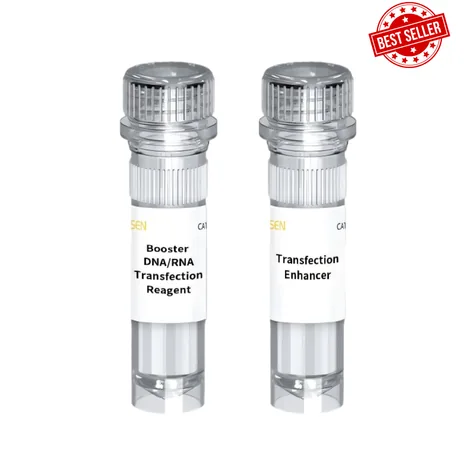
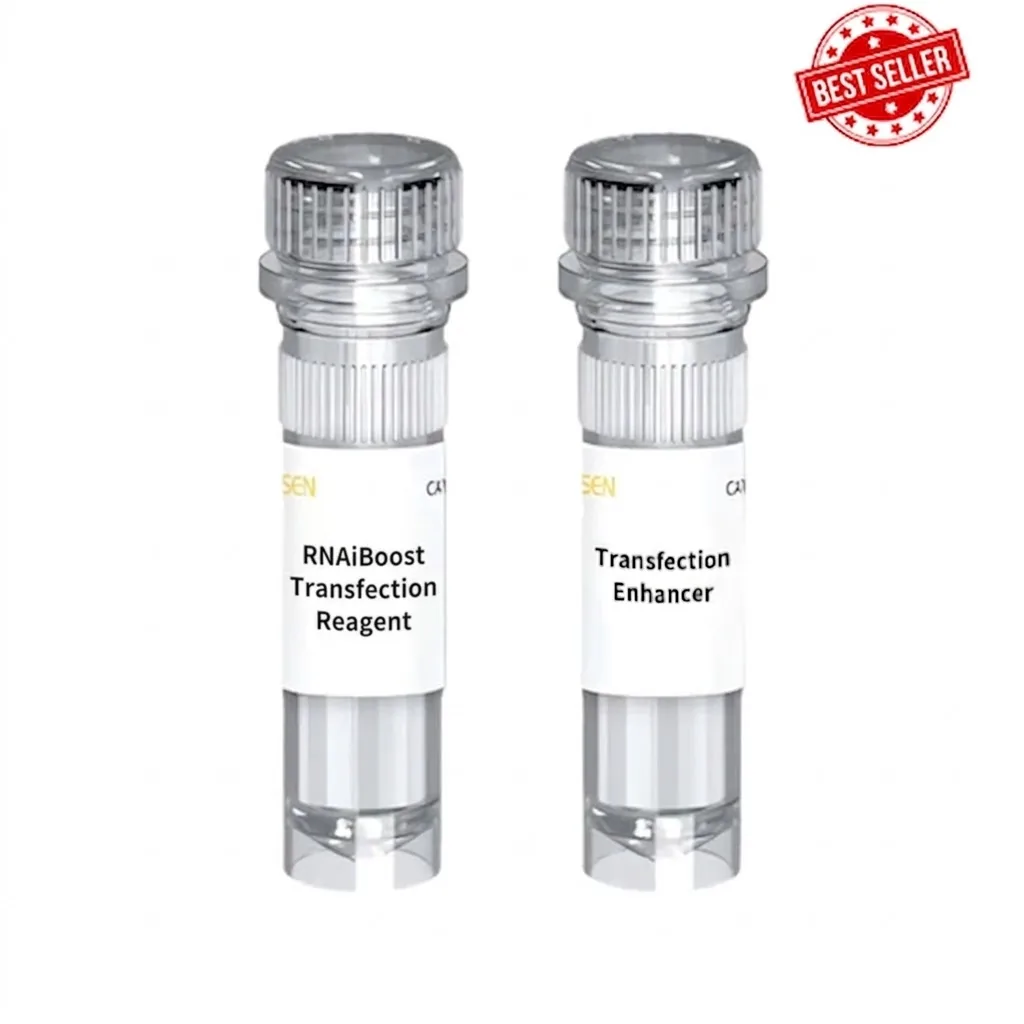
Booster 40801 is designed for DNA and RNA delivery. RNAiBoost 40807 is designed for siRNA, miRNA and ASO delivery. Choose according to your nucleic acid and cell model, and check the manufacturer application data.
Based on manufacturer specifications. Product documents and sources.
Which transfection reagent should you choose for DNA or siRNA?
Choose by the nucleic acid you want to deliver and your intended result. Plasmid expression, vector-based RNA interference and direct synthetic-siRNA delivery use different workflows.
For mRNA, miRNA or antisense oligonucleotide (ASO) work, choose a reagent whose manufacturer instructions include that application.
Sources: Invitrogen Lipofectamine 3000 manufacturer FAQs; Yeasen 40801 specifications; Yeasen RNAiBoost 40807 manual, EN20260202
Which YEASEN reagent supports your nucleic acid?
Compare the applications below with the manufacturer cell-model data on each product page. RNAiBoost's listed applications are siRNA, miRNA and ASO delivery; for DNA or mRNA, see Booster.
| Product | Listed nucleic acids | Supplied format |
|---|---|---|
| 40801 · Hieff Trans Booster | DNA, mRNA, siRNA, miRNA and ASO | Reagent plus a separate enhancer |
| 40807 · Hieff Trans RNAiBoost | siRNA, miRNA and ASO | Reagent plus a separate enhancer |
Sources: Yeasen 40801 specifications; Yeasen RNAiBoost 40807 manual, EN20260202
How should you choose a reagent for your cell model?
Compare manufacturer examples for your cell type, nucleic acid and intended readout. Check whether each example uses primary cells or an established cell line. Product pages link to the original manufacturer data and instructions.
For a new cell model, request a sample to evaluate performance in your assay. When asking for advice, include the specific cell type and whether you plan to measure expression, gene knockdown or another endpoint.
Sources: Yeasen 40801 specifications; Yeasen 40807 specifications
What are the advantages, and are the enhancers interchangeable?
YEASEN describes Booster as a next-generation polymer-based delivery reagent with broad DNA/RNA scope and data in selected primary and difficult-to-transfect cells. RNAiBoost is focused on small-RNA delivery; its reported >90% gene silencing is a result in tested models, not an efficiency guarantee for every target.
The components and instructions differ. Booster supplies an equal volume of enhancer, used in its DNA workflow but not required for mRNA or siRNA in manual EN20260916. RNAiBoost supplies three times the reagent volume as enhancer and includes it in the stated siRNA workflow. Do not exchange their enhancers or instructions.
RNAiBoost's five-minute claim refers to complex incubation. It is not a five-minute knockdown result. Neither product's broad scope validates every DNA topology; for closed-linear DNA, request specific evidence rather than assuming the small-RNA reagent is a match.
Sources: Yeasen 40801 specifications; YEASEN Booster 40801 manual — EN20260916; YEASEN RNAiBoost 40807 manual — EN20260202
Does low transfection efficiency mean you need a different reagent?
Not necessarily. YEASEN’s troubleshooting guidance identifies cell health, reagent suitability and the balance between delivery and toxicity as separate considerations. First distinguish a weak delivery readout from loss of viable cells or an unsuitable endpoint. Changing supplier alone does not identify the cause.
Before requesting a replacement sample, record the cell model, nucleic acid type, current reagent, observed problem and readout. Check the exact product’s current instructions and ask for relevant manufacturer data. A general troubleshooting article is not a validated protocol for every cell model.
Sources: YEASEN: troubleshooting transfection — common problems and solutions
How do delivery, knockdown and viability differ?
A fluorescent delivery measurement answers a different question from a reduction in target RNA or protein. For an RNAi application, select evidence that addresses the intended silencing endpoint and assess cell viability alongside it.
Manufacturer examples apply to their stated conditions. Use their controls and readout descriptions to judge relevance, while planning evaluation under the instructions for your chosen reagent. The general selection guidance cited here is not a replacement Yeasen protocol.
Sources: Thermo Fisher: evaluating siRNA transfection; Yeasen 40807 specifications
What should you compare in the complete transfection kit?
Both listed Yeasen families supply separate enhancer components. Compare the full contents of the exact catalogue pack rather than treating a reagent vial's volume as the whole kit.
Use the manufacturer's instructions for that family. Matching reagent volumes do not establish interchangeable formulations, enhancer components or methods, whether comparing two Yeasen products or an existing reference reagent.
Sources: Yeasen 40801 specifications; Yeasen 40807 specifications; Yeasen RNAiBoost 40807 manual, EN20260202
What should you include in an evaluation or quotation request?
Supply enough context to check the documented application and exact pack before committing to a larger order. Evaluation samples are subject to confirmation of format and availability.
- Nucleic acid type and intended result, such as plasmid expression or siRNA knockdown.
- Exact cell model and any relevant manufacturer example you have reviewed.
- Readout and cell-viability assessment used by your laboratory.
- Existing reference product, requested Yeasen catalogue number, pack size and quantity.
Sources: Yeasen 40801 specifications; Yeasen 40807 specifications; Thermo Fisher: evaluating siRNA transfection
Products and pack sizes
Select a product to view pack sizes and availability. Prices exclude VAT; delivery is calculated at checkout.
Need help choosing? Contact our team, request a quotation or request a free sample. Samples are subject to approval and availability.
Sources and further reading
- Yeasen 40801 specifications
- Yeasen 40807 specifications
- YEASEN Booster 40801 manual — EN20260916
- YEASEN RNAiBoost 40807 manual — EN20260202
- Yeasen RNAiBoost 40807 manual, EN20260202
- Thermo Fisher: evaluating siRNA transfection
- Invitrogen Lipofectamine 3000 manufacturer FAQs
- YEASEN: troubleshooting transfection — common problems and solutions
Follow the current instructions for the exact product and instrument you use. Products are for research use only.